Time Signatures & Rhythm in Grade 5 Music Theory
Simple vs compound time, grouping, and the 9/8 trap · 五級樂理節奏
Rhythm questions open every Grade 5 paper, and one misunderstanding causes most of the dropped marks: reading the top number of a compound time signature as the number of beats. Fix that one idea and this whole section gets easier.
Simple vs compound time
In simple time the beat divides into two; in compound time it divides into three. Compound time signatures have 6, 9 or 12 on top — and the number of beats is that number divided by three, because each beat is a dotted note.
| Time signature | Beats per bar | Beat unit |
|---|---|---|
| 2/4, 3/4, 4/4 (simple) | 2, 3, 4 | crotchet |
| 3/8 (simple) | 3 | quaver |
| 6/8 (compound duple) | 2 | dotted crotchet |
| 9/8 (compound triple) | 3 | dotted crotchet |
| 12/8 (compound quadruple) | 4 | dotted crotchet |
So 9/8 has three dotted-crotchet beats — not nine quaver beats. The exam tests this directly ("how many beats in a bar of 9/8?") and indirectly through grouping questions.
Grouping and beaming: beams show the beats
The rule behind every grouping question: beaming should make the beat structure visible. In 6/8, quavers beam in two groups of three (3+3); in 9/8, three groups of three (3+3+3). In simple time, beams group by crotchet beat. If a rhythm is written so you can't see where the beats fall, it's wrongly grouped — that's usually the wrong answer in a multiple-choice question, and knowing why lets you spot it fast.
Irregular time: 5/8 and 7/8
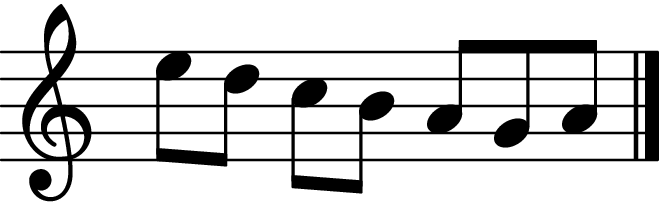
7/8 and 5/8 don't divide into equal beats — they're built from unequal groups (2+2+3, 3+2+2, 2+3). You'll never see seven identical quavers beamed as one lump; the groups are always shown. When a grouping question offers you a bar of evenly-beamed quavers in an irregular metre, that's the distractor.
Rests complete the beat
The same show-the-beats logic applies to rests: rests should fill each beat (or whole beats) without hiding where beats begin. A common exam question shows a bar with a missing portion and asks which rest(s) complete it — count what each beat still needs, beat by beat, rather than the whole bar at once.
Practise with real exam-style questions
Tonica's mock papers open with rhythm questions in the real ABRSM format — grouping, time signatures, rests — with instant marking and an explanation for every answer, in English and 中文. Paper 1 is completely free, no signup.
Try rhythm questions free →免費節奏練習 · 即時評分 · 中英雙語